Construction Loan Overview
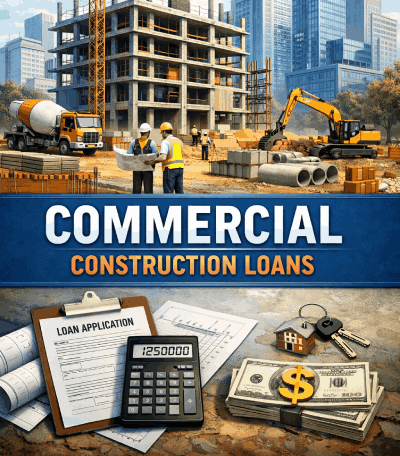
Commercial Loan Direct offers construction financing for ground-up commercial real estate development across all major property types. We work with developers, investors, and owner-operators to structure loans that cover the building phase and transition smoothly into permanent financing at project completion.
Our two core construction programs are:
- Conventional Construction Loans — $1MM to $100MM, up to 70% LTC/LTV, for most commercial property types nationwide
- SBA 504 Construction — $750K to $10MM, up to 90% LTV, for owner-occupied multi-use and eligible special-use properties
What Is a Commercial Construction Loan?
A commercial construction loan is a short-term, interest-only facility that finances the ground-up development or substantial renovation of a commercial property. Unlike a term loan — where the full balance is disbursed at closing — construction loan funds are advanced in stages called draws as construction milestones are verified and completed.
Once construction is complete and the property is ready for occupancy, the construction loan is paid off through one of two paths: the borrower refinances into a permanent loan, or a construction-to-permanent structure converts automatically at a pre-agreed conversion date. During the construction period, the borrower pays interest only on the amount drawn to date — not on the full committed loan amount.
Construction Loan Key Metrics
Property Types Eligible for Construction Financing
Conventional construction loans are available for most commercial property types. SBA 504 construction programs require a multi-use or eligible special-use property located within an identifiable Metropolitan Statistical Area (MSA).
Multifamily
Ground-up apartment buildings and mixed-income residential developments. Conventional and SBA programs available.
Office
Single-tenant and multi-tenant office buildings, medical office, and professional campuses. Owner-occupied qualifies for SBA.
Retail
Strip centers, single-tenant retail, and mixed-use retail bases. Pre-leasing requirements may apply for conventional programs.
Industrial / Warehouse
Distribution centers, manufacturing facilities, and flex space. Strong demand drivers from e-commerce and reshoring trends.
Hotel / Hospitality
Flagged and independent hotel development. Experienced sponsorship and franchise agreements are key underwriting factors.
Mixed-Use
Ground-up development combining retail, residential, and office uses. SBA 504 available for eligible owner-occupied components.
Healthcare / Medical
Medical office buildings, outpatient surgery centers, and assisted living facilities. SBA special-use programs apply.
Self-Storage
Climate-controlled and traditional self-storage facilities. Strong cash-on-cash returns drive demand for construction capital.
How the Construction Loan Draw Process Works
Understanding the draw process is essential for managing project cash flow and lender relationships during construction. Here's how funds flow from approval to final disbursement:
Loan Approval and Initial Funding
After closing, the lender establishes a construction loan account. A reserve account is typically funded to cover monthly interest payments on the borrower's behalf until the project reaches take-out — smoothing cash flow during the building phase.
Construction Begins — Builder Mobilizes
The general contractor — who must be pre-approved by the lender — mobilizes on site. Construction contracts, detailed cost breakdowns, plans and specifications, and all required building permits must be in place before any draws are funded.
Draw Requests Submitted
As construction milestones are reached, the contractor submits a draw request with supporting documentation — AIA schedules of values, lien waivers, and invoices. The frequency is typically monthly or at agreed completion stages.
Lender Inspection and Fund Control Review
The lender (or fund control company) sends an inspector to verify that the completed work matches the draw request. If SBA financing exceeds 65% LTV and construction costs exceed $500,000 (or 25% of total project cost), a third-party performance guaranty is also required.
Draw Funded — Builder Paid in Arrears
Once the inspection is approved, the draw is funded. Critically, builders are paid in arrears — after work is completed and verified, not before. This protects the lender and ensures the loan balance tracks actual construction progress.
Construction Complete — Certificate of Occupancy
When construction finishes, the borrower obtains a Certificate of Occupancy. This triggers the final draw and signals readiness for take-out financing or automatic conversion to a permanent loan.
Take-Out Financing / Permanent Loan
The construction loan is repaid through a permanent loan (conventional, CMBS, SBA, or agency). For SBA 504 construction projects, the SBA debenture portion requires SBA approval prior to the permanent lender's commitment.
Construction Commercial Loan Programs
Select a program below to view detailed rate and term information for each construction loan type.
| Loan Type | Rates | Properties | Loan Amount | Max LTV | Term | Amortization |
|---|---|---|---|---|---|---|
| SBA Construction | 5.75% - 9.00% | Industrial, Medical, Mixed-Use, Office, Retail |
$3,000,000+ | 80% | 1 - 3 Years |
15 - 30 Years |
| Loan Type | Rates | Properties | Loan Amount | Max LTV | Term | Amortization |
|---|---|---|---|---|---|---|
| Conventional Construction | 5.75% - 9.00% | Apartment, Industrial, Medical, Mixed-Use, Office, Retail, Self-Storage |
$1,000,000+ | 70% | 1 - 3 Years |
15 - 30 Years |
Conventional Construction Loan Terms
| LTV: Up to 70% loan to cost or loan to value (whichever one is lower) | |
| Coverage Area: | Nationwide (primary and secondary markets preferred). |
| Loan Amount: | $1MM to $100MM. |
| Experience: | Prior construction experience highly preferred. |
| Property Types: | Most property types considered. |
| Occupancy: | Owner occupied and investment properties. |
| Rate: | Starting rate at Prime + 1 (floor rate might be required) |
| Amortization: | Interest only during construction. |
| Reserve account: | A reserve account will be used to make monthly payments on behalf of Borrower until construction phase is finished and property is ready for take-out financing. |
| Builder: | Must be approved by lender. Builders get paid in arrears. |
SBA 504 Construction Loan Terms
| 90% LTV Commercial Construction Loans (with SBA 504 Program) | |
| Construction Loans - Interest Rate: |
|
| Commercial Construction Loans Fee: | 1.0% Minimum |
| Eligible Properties for Commercial Construction Loans: | Multi-use properties and currently acceptable special use properties will be considered if the credit is sufficiently strong to justify the transaction. Must be located in an identifiable MSA. The project must be located in an area suitable for the intended use. Construction costs must be within acceptable norms (no unusual types of construction or elaborate improvements will be allowed) |
| Borrower / Eligible Operating Company Requirements: | Borrower / operating company must have generated a DCR of ≥ 1.25 for the proposed debt over the past two years or have acceptable trends if a proposed expansion. Four years of operating history or equivalent ownership experience — profitability, retained earnings / equity, and leverage must all be equal to, or better than, the specific industry's average. Borrower / guarantors must demonstrate strong credit characteristics including cash flow and liquidity adequate to pay for possible cost overruns of 10–15% of hard costs after equity injection. Combined outside net worth of the owners should be approximately 35% of the proposed loan amount. FICO score of ≥ 700 for all owners (with more than 20% ownership interest). Ineligible if borrower, OC or principal has previously filed for protection under US bankruptcy law. |
| Fund Control / Bond / Third Party Guaranty: | Lender will select the fund control company. In addition to fund control, if lender exceeds 65% and construction costs exceed $500,000 (or 25% of total project cost) lender requires a third party performance guaranty. |
| Permanent Loan: | Lender's current permanent loan program remains in effect. Approval by the SBA will be required prior to the lender. |
| Underwriting Requirements: | In addition to the normal term loan underwriting requirements a Contractor Qualification statement acceptable to lender, detailed cost breakdown, construction contract, plans and specifications, and building permits are required. |
| Fee Summary: | The lender's Construction Loan Fee is 1% of the construction loan amount, loan Documentation Fee is $1,800. The Initial Project Review, Fund Control and Guaranty are quoted on a case by case basis. |
| Commercial Construction Loans Size: | $750,000 – $10,000,000 |
| Maximum LTVs (per SBA 504 guidelines): |
|
Qualifying for a Construction Commercial Loan
Construction loans carry more risk than permanent loans — the collateral doesn't exist yet — so lenders have stricter requirements. Here are the core qualification criteria:
Prior Construction Experience
Highly preferred for conventional programs and required for SBA. Borrowers without direct experience can sometimes qualify by partnering with an experienced co-developer or by using a highly qualified general contractor with a verifiable track record.
Borrower Net Worth & Liquidity
SBA requires combined outside net worth of approximately 35% of the loan amount. Borrowers must also demonstrate liquidity sufficient to cover 10–15% of hard construction costs as a cost overrun cushion after equity injection.
Equity / Down Payment
Conventional programs require 30%+ equity (30% of total project cost). SBA 504 can reduce equity requirements to as low as 10% for eligible multi-use projects. Equity can come from land equity, cash, or approved equity-equivalent sources.
Credit Score
SBA programs require a minimum FICO of 700 for all principals with more than 20% ownership. Conventional lenders typically require 680+. Bankruptcy history disqualifies borrowers from SBA construction programs.
Debt Coverage Ratio (DCR)
SBA requires the borrower's operating company to have maintained a DCR of 1.25x or better for the past two years — or demonstrate acceptable expansion trends. Cash flow from existing operations helps offset the risk of a new development project.
Approved General Contractor
The general contractor must be pre-approved by the lender. A Contractor Qualification Statement, detailed cost breakdown, construction contract, and plans and specifications are required at application. Contractors must have appropriate licensing and insurance.
Construction-to-Permanent Financing
One of the most important planning decisions in any construction project is how the construction loan will be paid off at completion. There are two primary take-out paths:
The construction loan and the permanent loan are two separate transactions with two separate closings. The construction loan closes at the start of the project. Once complete and stabilized, the borrower applies for and closes a new permanent loan. Advantage: More flexibility to shop permanent financing at stabilization. Disadvantage: Two sets of closing costs and rate risk at conversion.
A single loan that starts as an interest-only construction facility and converts automatically to a permanent amortizing loan at a pre-agreed maturity date. Advantage: One closing, locked permanent rate, no conversion risk. Disadvantage: Rate is locked at origination; if permanent rates drop, you can't benefit without refinancing.
For SBA 504 construction transactions, the SBA debenture component requires SBA approval prior to the permanent lender's commitment. Contact a loan officer at 1-800-687-0797 to discuss which structure works best for your project timeline and risk profile.